
Beyond Testing: The QA Orchestration Crisis

Beyond Testing: The QA Orchestration Crisis
Why Fragmented Validation Is Becoming The Biggest Operational Bottleneck In Enterprise QA.
Modern enterprises have already invested heavily in automation, CI/CD pipelines, cloud-native engineering, and AI-assisted development. Yet software quality issues continue to surface across enterprise delivery environments despite growing investments in testing tools and automation frameworks.
The reason is not a lack of testing.
It is the growing fragmentation of enterprise QA operations.
At Changepond Technologies, this became increasingly visible across modernization initiatives spanning banking, insurance, healthcare, and digital commerce platforms. QA environments evolved into disconnected operational layers involving separate tools, frameworks, reporting systems, and validation processes. Functional testing, visual assurance, accessibility validation, performance engineering, API testing, and security analysis often operate independently despite contributing to the same release lifecycle.
As delivery complexity increased, enterprises continued adding new validation layers without fundamentally restructuring how those systems operate together.
This is where enterprise QA is beginning to change.
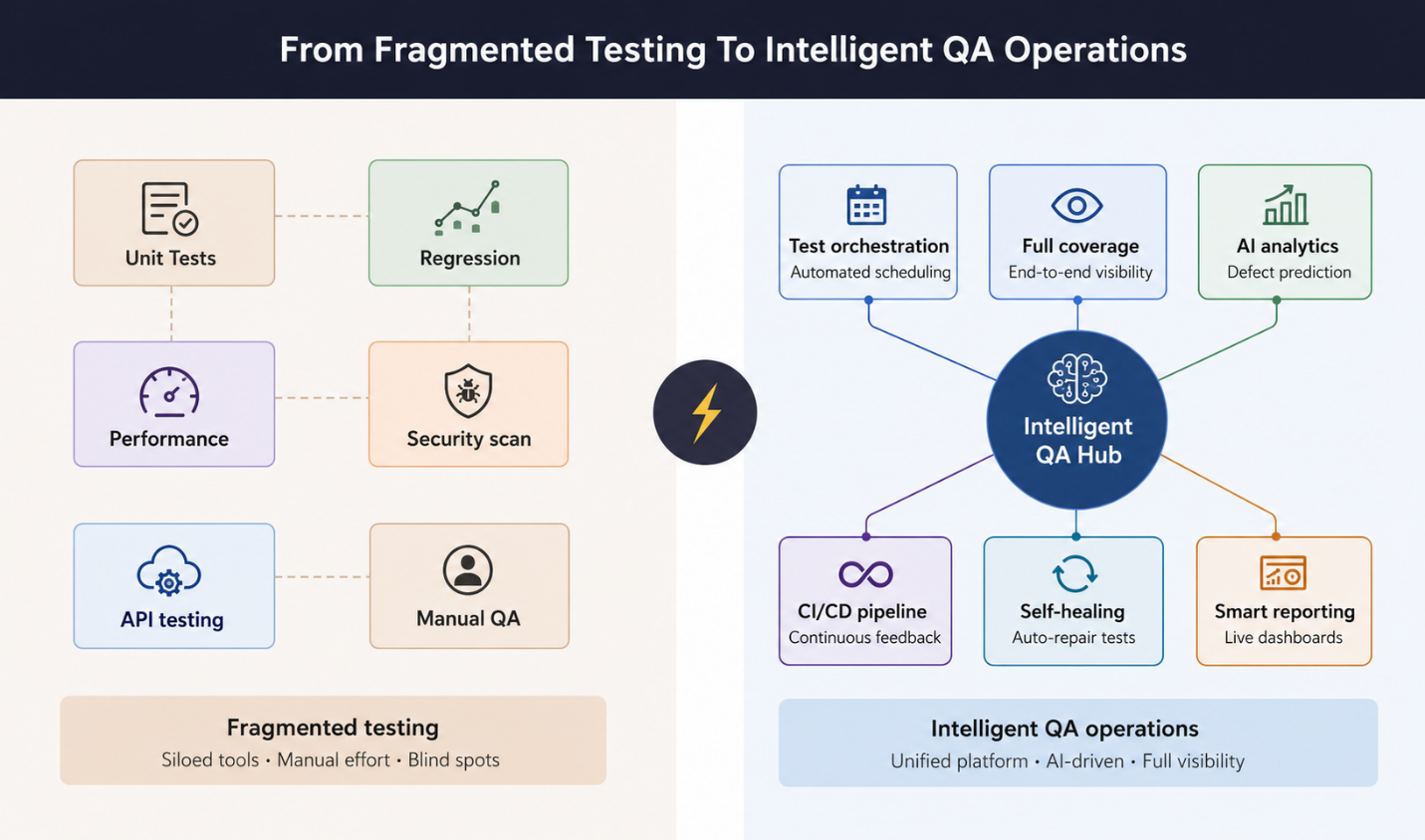
The Problem with Modern QA Is Not Automation. It Is Fragmentation.
Most enterprise QA environments did not become fragmented intentionally. They evolved incrementally over years of delivery pressure, tooling decisions, and operational expansion.
As organizations accelerated digital transformation initiatives, QA teams adopted specialized platforms for functional testing, performance engineering, accessibility validation, API testing, visual assurance, security scanning, and cross-browser compatibility. Each layer solved a specific operational challenge, but very few enterprises restructured how these systems would operate together as a unified validation strategy.
The result is a testing ecosystem that often functions in silos rather than as a coordinated quality operation.
Today, enterprise QA teams frequently manage disconnected frameworks, separate reporting environments, duplicated validation logic, and increasing orchestration overhead across release cycles. Teams validate applications independently while release operations continue to depend on fragmented workflows, manual coordination, and isolated quality intelligence.
This creates a fundamental visibility problem. Enterprises may achieve strong validation coverage at the system level while still struggling with operational inefficiencies, delayed release confidence, inconsistent reporting, and fragmented defect visibility.
The problem is no longer a lack of automation.
It is the operational fragmentation of validation itself.
Why This Matters Now
Three major shifts are forcing enterprises to rethink QA operations.
Release velocity increased faster than validation maturity
CI/CD accelerated software delivery significantly, but QA operating models did not evolve at the same pace.
Many enterprises still rely on fragmented validation pipelines, isolated reporting structures, and manually coordinated testing workflows. The result is faster deployment cycles paired with slower release confidence, increasing production defects and operational coordination overhead.
Enterprises are now shipping software faster than they can confidently validate quality at scale.
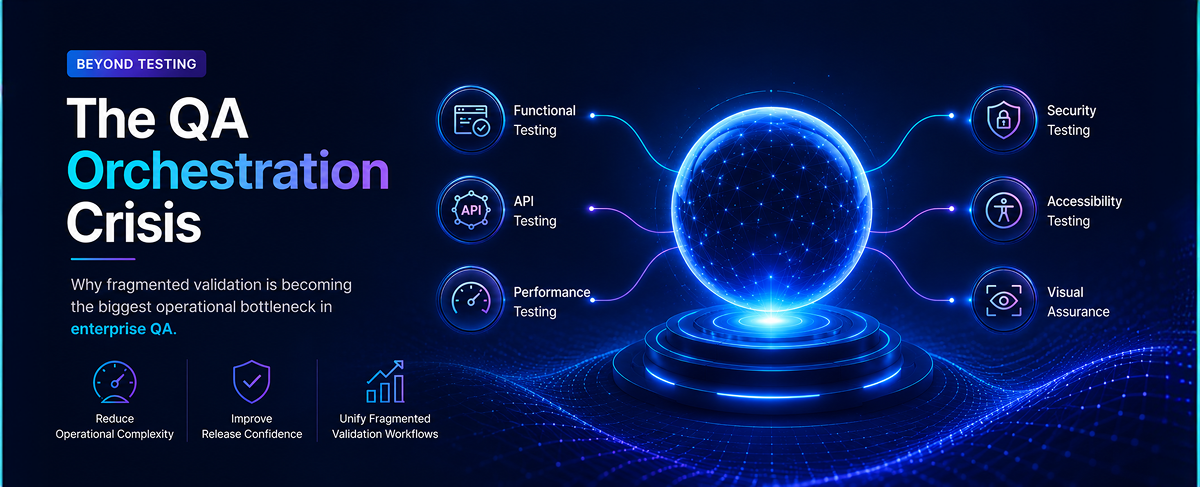
Enterprise QA Ecosystems Became Operationally Complex
Over time, QA environments expanded into collections of specialized tools, frameworks, scripts, pipelines, and reporting layers managed across different teams.
While each platform solves a specific validation requirement, the orchestration complexity between systems continues to grow. Teams spend increasing amounts of time coordinating execution flows, consolidating reports, maintaining integrations, and managing fragmented validation cycles.
In many environments, operational coordination is becoming more difficult than testing itself.
AI Changed Expectations Around Engineering Productivity
Enterprise leadership is no longer asking whether QA can automate testing. The focus has shifted toward orchestration, intelligence, and operational efficiency.
Why are engineering teams still manually coordinating multiple frameworks, reporting systems, and validation pipelines?
AI is changing expectations across software delivery, not only in development but also in orchestration, intelligence, prioritization, and operational decision-making. That pressure is now reaching enterprise QA organizations.
Industry Shift
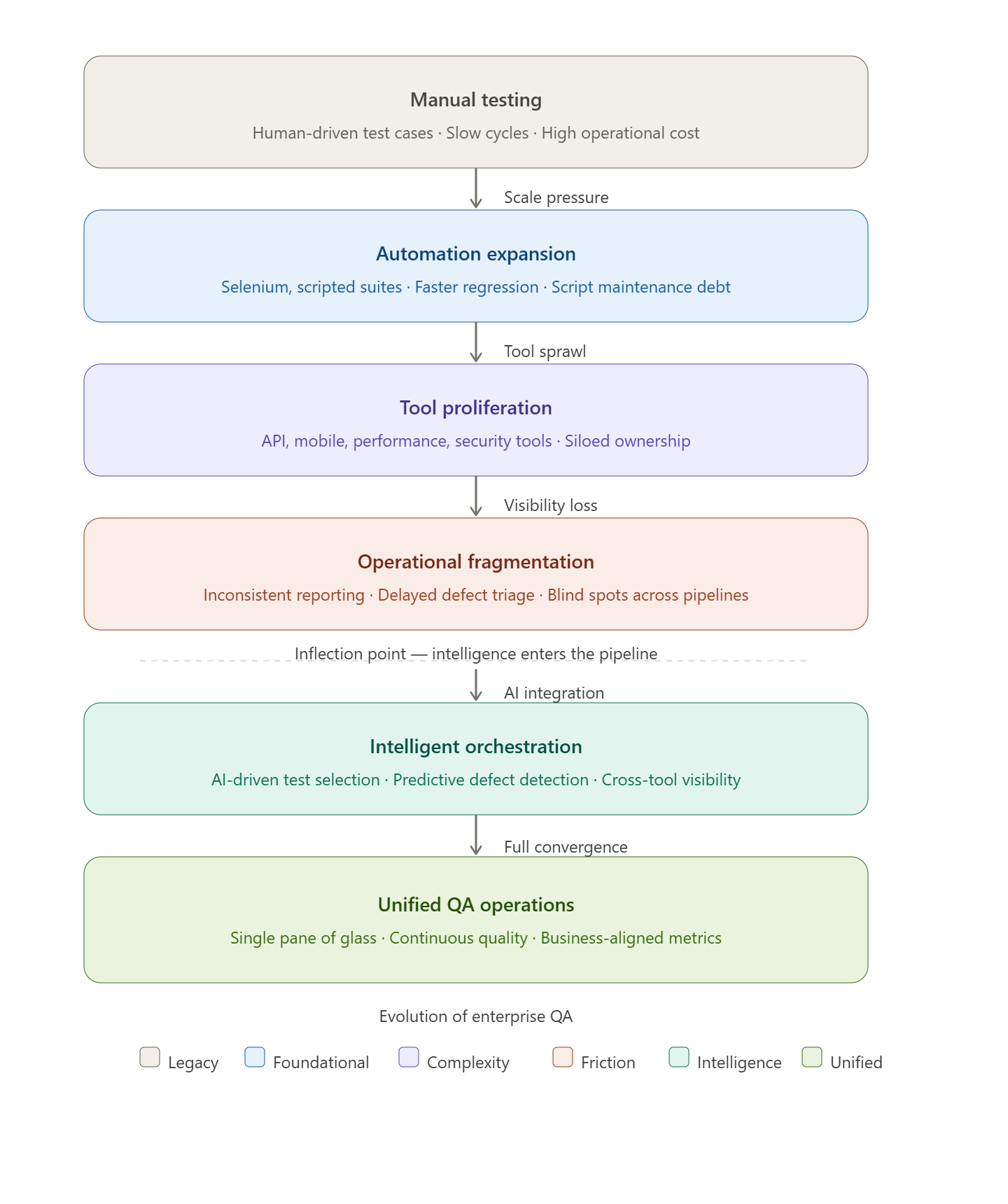
The Shift Toward Intelligent QA Operations
The future of QA is not more automation.
It is intelligent orchestration.
This requires enterprises to move away from isolated validation models and toward connected QA operations built around centralized execution, unified intelligence, and operational visibility.
Traditional QA Thinking | Intelligent QA Operations |
Manage testing tools independently | Operate through unified orchestration |
Focus on execution coverage | Focus on operational visibility |
Sequential validation workflows | Parallel multi-dimensional validation |
Fragmented reporting systems | Unified quality intelligence |
Manual coordination overhead | AI-assisted orchestration |
Reactive defect management | Predictive quality insights |
Modern QA operations are increasingly shifting from isolated testing activities toward connected validation ecosystems designed to reduce operational complexity across software delivery.
“Enterprise QA has reached a point where execution alone is not enough. The real differentiator is how effectively organizations orchestrate validation across tools, teams, and delivery pipelines.” – Senthil Rudrappa – QA Lead
What Intelligent QA Operations Actually Look Like
Enterprise QA is shifting from fragmented validation toward unified orchestration designed around centralized execution models.
Instead of operating separate systems for functional testing, accessibility validation, security testing, performance engineering, API validation, and visual assurance, enterprises are beginning to orchestrate these capabilities together within connected operational workflows.
In practice, this includes:
- Centralized validation orchestration
- AI-assisted test generation
- Parallel multi-dimensional execution
- Unified defect intelligence
- Continuous CI/CD integration
- Centralized reporting and release visibility
The objective is not simply faster testing.
It is reducing operational friction across enterprise software delivery while improving release confidence.
Unified QA Operations Architecture
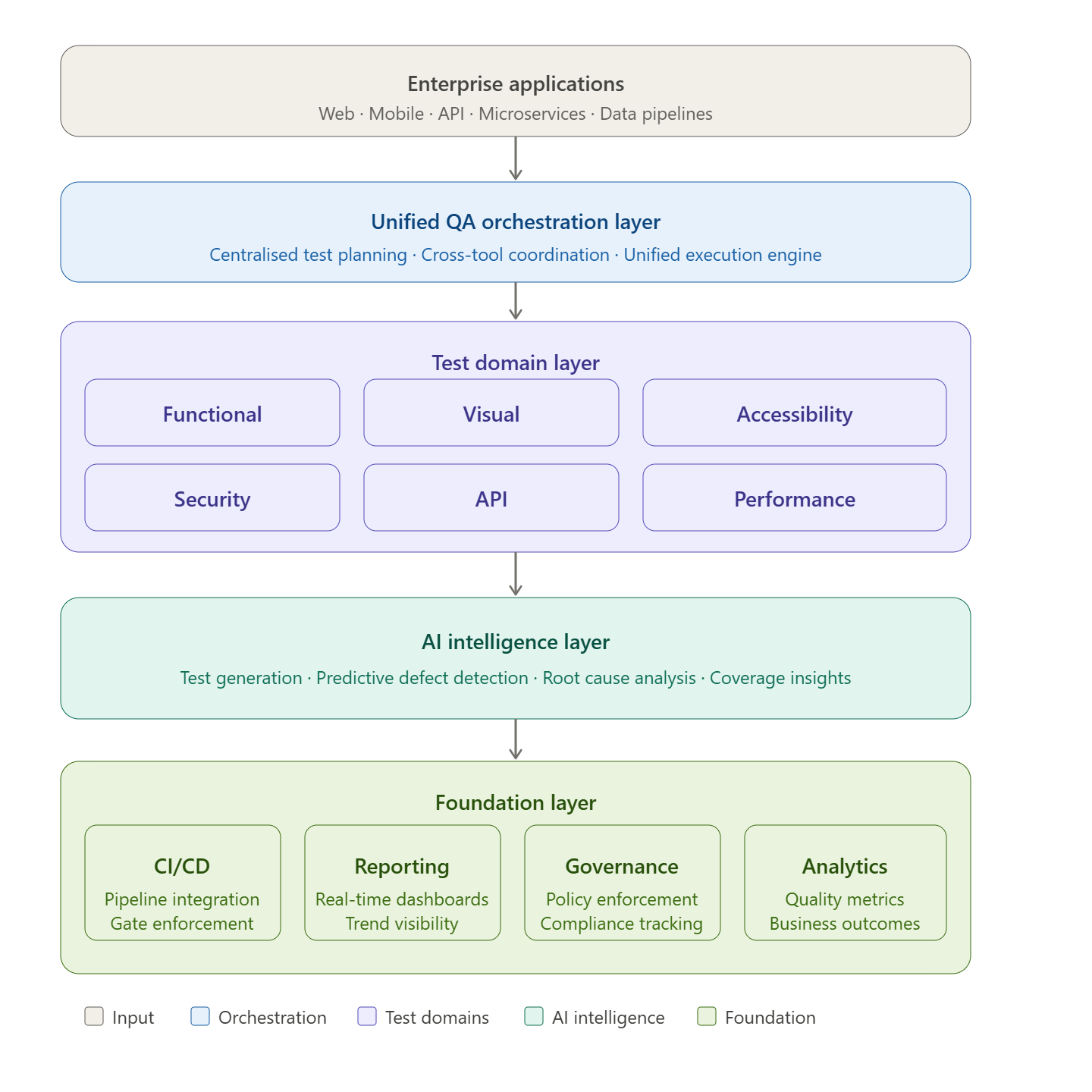
The Enterprise Shift Toward Customer-Centric QA
At Changepond, this thinking contributed to the evolution of ICE Intelligent Customer Experience a unified QA platform designed to reduce operational fragmentation across enterprise testing environments.
The foundational idea was straightforward:
Enterprise QA evolved tool by tool. Modern software delivery now demands orchestration.
That operational gap became increasingly visible during enterprise QA transformation initiatives involving customer-facing digital platforms.
Over time, the approach evolved toward unified validation across functional testing, visual assurance, accessibility compliance, network performance, security analysis, API testing, and cross-browser compatibility all orchestrated through connected operational workflows rather than disconnected frameworks.
The objective was never to build another testing tool.
It was to reduce friction across enterprise QA operations.
Why Fragmented QA Is Becoming a Business Risk
Fragmented QA operations create more than engineering inefficiencies.
They create operational bottlenecks across enterprise software delivery.
As validation ecosystems become increasingly disconnected, enterprises face growing challenges around release confidence, reporting consistency, defect visibility, execution coordination, and operational scalability.
Modern enterprises no longer compete solely on software functionality.
Increasingly, they compete on delivery speed, operational responsiveness, and release reliability.
Organizations that continue operating fragmented validation ecosystems may struggle to maintain those expectations at scale.
Conclusion: The Future of QA Is Operational
Enterprise QA is entering a new phase.
For years, organizations focused primarily on expanding automation coverage, accelerating execution, and scaling delivery pipelines. But as enterprise ecosystems became more complex, the operational challenge shifted from simply running tests to orchestrating validation across fragmented systems, tools, workflows, and reporting layers.
That shift is now redefining how modern QA environments are being designed.
The future of enterprise quality assurance will likely depend less on how many testing tools organizations operate and more on how effectively they unify execution, intelligence, reporting, and operational visibility across the delivery lifecycle.
This article is the first in Changepond’s Intelligent QA Operations series exploring how enterprise quality engineering is evolving from fragmented testing models toward unified operational orchestration.
In the next article, we move from strategy into engineering execution and examine how modern QA orchestration platforms are being architected to support centralized workflows, AI-assisted execution, and connected quality operations at enterprise scale. For more information you can email us at info@changepond.com or visit www.changepond.com.
See Where QA Orchestration Can Reduce Release Friction →
Frequently Asked Questions
What is fragmented QA?
Fragmented QA refers to disconnected testing environments where functional testing, accessibility validation, performance engineering, API testing, security analysis, and reporting systems operate independently rather than through a unified orchestration model.
Why is QA orchestration becoming important?
As enterprise software delivery environments become more complex, organizations are struggling with disconnected workflows, fragmented reporting, operational coordination overhead, and delayed release visibility. QA orchestration helps unify validation operations across multiple testing layers.
What are intelligent QA operations?
Intelligent QA operations combine centralized orchestration, AI-assisted execution, unified reporting, and connected validation workflows to reduce operational complexity across enterprise software delivery environments.
How is AI changing enterprise QA?
AI is shifting QA from manual coordination toward intelligent orchestration. Modern QA environments increasingly use AI for test generation, execution optimization, defect analysis, predictive insights, and operational visibility.
What operational challenges do enterprises face with fragmented QA?
Common challenges include:
- Disconnected testing frameworks
- Manual orchestration overhead
- Delayed release confidence
- Fragmented reporting systems
- Duplicate validation efforts
- Limited operational visibility
- Increased maintenance complexity
What is ICE by Changepond?
ICE -Intelligent Customer Experience is Changepond’s unified QA platform designed to reduce operational fragmentation across enterprise testing environments through connected validation workflows and centralized orchestration.