
What AI Actually Means in Software Testing
(Beyond the Hype)

What AI Actually Means in Software Testing (Beyond the Hype)
AI in testing is surrounded by exaggerated promises and understandable skepticism. Enterprise leaders want clarity: what is real, what is experimental, and what delivers measurable value today?
The most important distinction is this:
AI in QA is augmentation, not replacement.
It enhances tester capability by accelerating effort-heavy tasks while preserving human judgment.
More importantly, AI is only as effective as the test design and data strategies behind it. Without structured inputs, even the most advanced models fail to deliver reliable outcomes.
Where AI Creates Immediate Impact
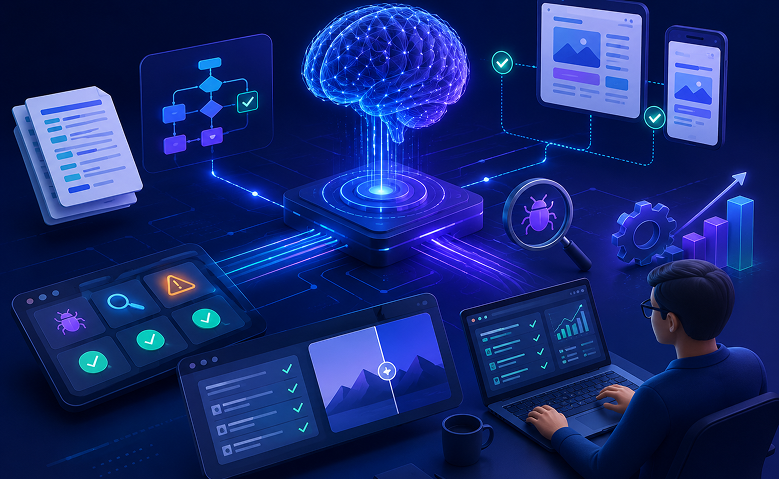
AI is already delivering value in core testing functions:
- Requirement understanding
AI models interpret user stories and translate them into structured test scenarios. - Test case generation
Large test suites can be created in minutes rather than weeks. - Automation assistance
Scripts adapt to UI changes through intelligent self-healing. - Regression optimization
AI selects tests based on risk, usage, and historical failure patterns. - Defect intelligence
Clustering and root cause analysis reveal systemic issues.
These capabilities transform testing from static execution into a continuously improving system.
From Bottlenecks to Acceleration: A Real-World Shift
The Reality: When Manual Testing Slows Down Innovation
A leading enterprise banking product organization faced growing QA inefficiencies:
- Excessive manual testing effort (1000+ hours per release cycle)
- Repeated regression cycles with limited coverage
- Delays due to manual UI validation
- Inconsistent defect detection across environments
- Heavy dependency on QA teams for visual validation
Testing had become a bottleneck to release velocity.
The Changepond Approach: AI-led Visual Testing Automation
We transformed their QA process using AI-powered visual testing integrated with Intelligent Continuous Engineering (ICE):
- Programmatic capture of design specifications
- Automated visual validation across environments
- CI/CD integration (BAT, SIT, UAT)
- Early detection of even minor UI deviations
- Alignment with DevOps practices
Measured Business Impact
- 98% effort reduction (1000 hours → ~20 hours)
- Automation embedded across the delivery pipeline
- Coverage expanded across 15+ resolutions
- Early defect detection through shift-left adoption
- Faster and more reliable releases
This is the difference between AI as experimentation vs AI as engineered capability.
Human + AI Collaboration
Effective AI testing environments do not remove testers. They elevate them.
Testers move from execution-heavy roles to:
- strategy design
- exploratory testing
- risk evaluation
- model supervision
- quality analytics
AI becomes a co-engineer, not a replacement.
AI Embedded in the SDLC
When AI is integrated across the SDLC, testing becomes a real-time feedback system that supports engineering decisions.
Changepond’s AI-powered SDLC framework positions QA as an intelligence layer embedded across design, development, and release readiness.
Quality stops being a late-stage activity. It becomes a delivery accelerator.
However, isolated AI pilots rarely scale without a structured approach.
From Experimentation to Structured Adoption
A key challenge we consistently hear from QA leaders is not whether AI works—but where it works and how much impact it can deliver.
This is where an AI-led QA discovery approach becomes critical:
- Identifying high-impact use cases
- Evaluating test design and data readiness
- Mapping AI applicability across the lifecycle
- Estimating measurable outcomes upfront
AI adoption succeeds when it is intentional, governed, and outcome-driven.
AI in QA is no longer about isolated experiments.
It is about building a structured, scalable, and intelligent Quality Engineering model that aligns with real-world constraints and delivers measurable impact.