
AI-Ready Requirements: The Missing Link In AI-Assisted Development

How Requirement Quality Shapes Architecture, Scaffolding, and AI-Assisted Development.
In the previous article, we looked at how a fragmented QA problem became a modular platform architecture: 60 functional requirements organized into 18 Maven modules.
This article moves one step earlier.
Before architecture becomes modular, before scaffolding begins, and before AI can generate anything useful, the requirement has to be clear enough to build from.
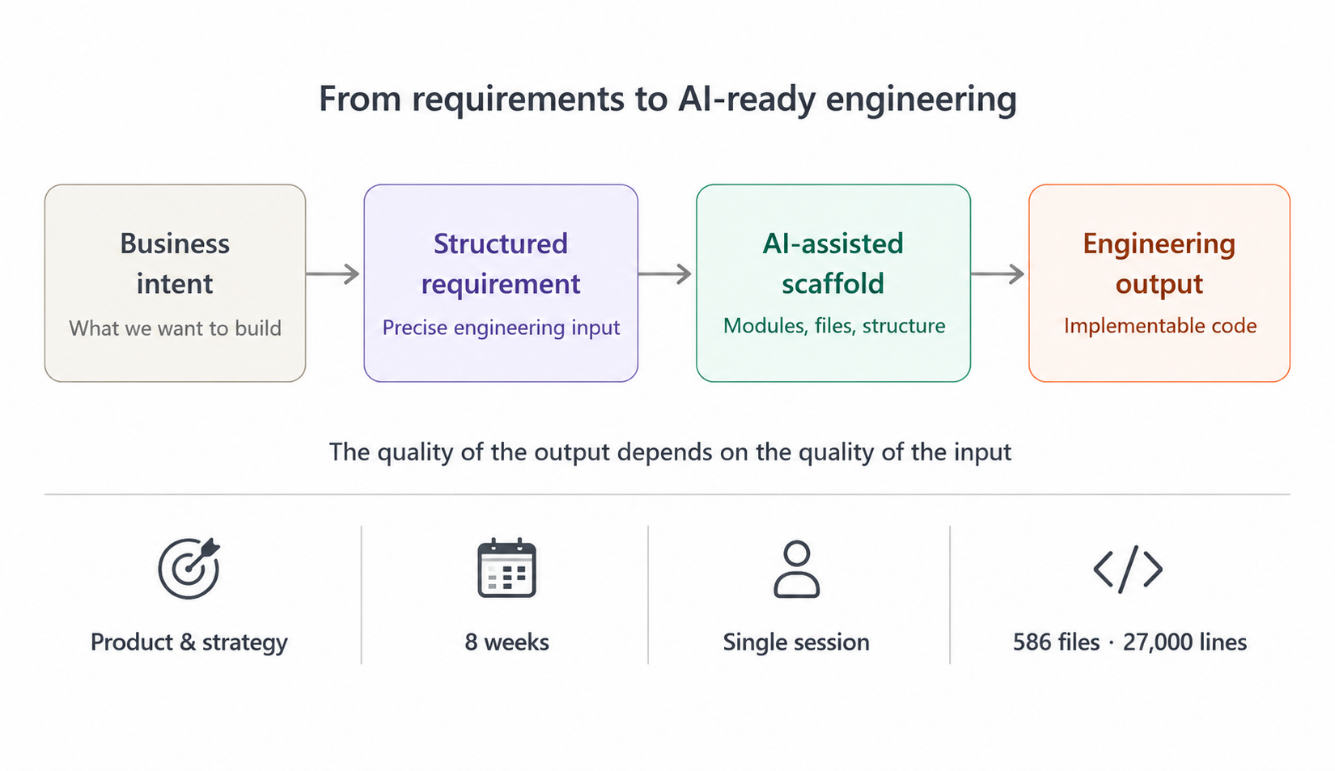
That was one of the biggest lessons from the ICE requirement-writing process. For ICE Changepond’s Intelligent Customer Experience platform the functional requirements were written over eight weeks. The scaffold generation that followed happened in a single extended session: 18 modules, 586 files, and 27,000 lines of Java, SQL, YAML, and configuration.
That contrast reveals an important lesson for enterprise engineering teams:
AI does not remove the need for clear thinking. It increases the value of it.
When AI becomes part of development, requirements are no longer just communication documents. They become engineering inputs that shape scaffolds, module boundaries, data models, error handling, acceptance criteria, and implementation quality.
KEY INSIGHT
AI does not remove the need for clear thinking. It increases the value of it.
Why Requirements Matter More In AI-Assisted Development
Traditional requirement writing often assumes a human interpretation layer.
A business analyst writes the requirement. A developer reads it. Questions follow. Gaps are clarified in meetings. Assumptions are resolved through discussion and experience.
AI-assisted development changes that dynamic.
With AI, the requirement becomes much closer to a contract. What is specified gets reflected in the scaffold. What is missing often stays missing. What is ambiguous can become structurally ambiguous.
That means requirement quality directly affects data models, service boundaries, API behavior, error handling, validation logic, acceptance criteria, and developer handoff quality.
The quality of the output depends on the quality of the input.
This is why AI-assisted development does not reduce the need for engineering discipline. It moves that discipline upstream.

Industry Signal: Poor Requirements Still Break Delivery
Poor requirements have always been a delivery risk.
PMI’s Pulse of the Profession research found that nearly half — 47% — of unsuccessful projects fail to meet goals due to inaccurate requirements management.
Source: PMI, Requirements Management: A Core Competency for Project and Program Success (https://www.pmi.org/learning/thought-leadership/pulse/core-competency-project-program-success)
That matters even more when AI becomes part of the engineering workflow.
In traditional delivery, vague requirements may trigger clarification meetings. In AI-assisted development, vague requirements can shape unclear scaffolds, weak boundaries, incomplete acceptance criteria, and higher rework.
The implication is clear: AI-ready requirements need to be structured, testable, and architecture-aware from the start.
From Product Description to Engineering Contract
A typical product requirement explains what a feature should do.
An AI-ready functional requirement goes further.
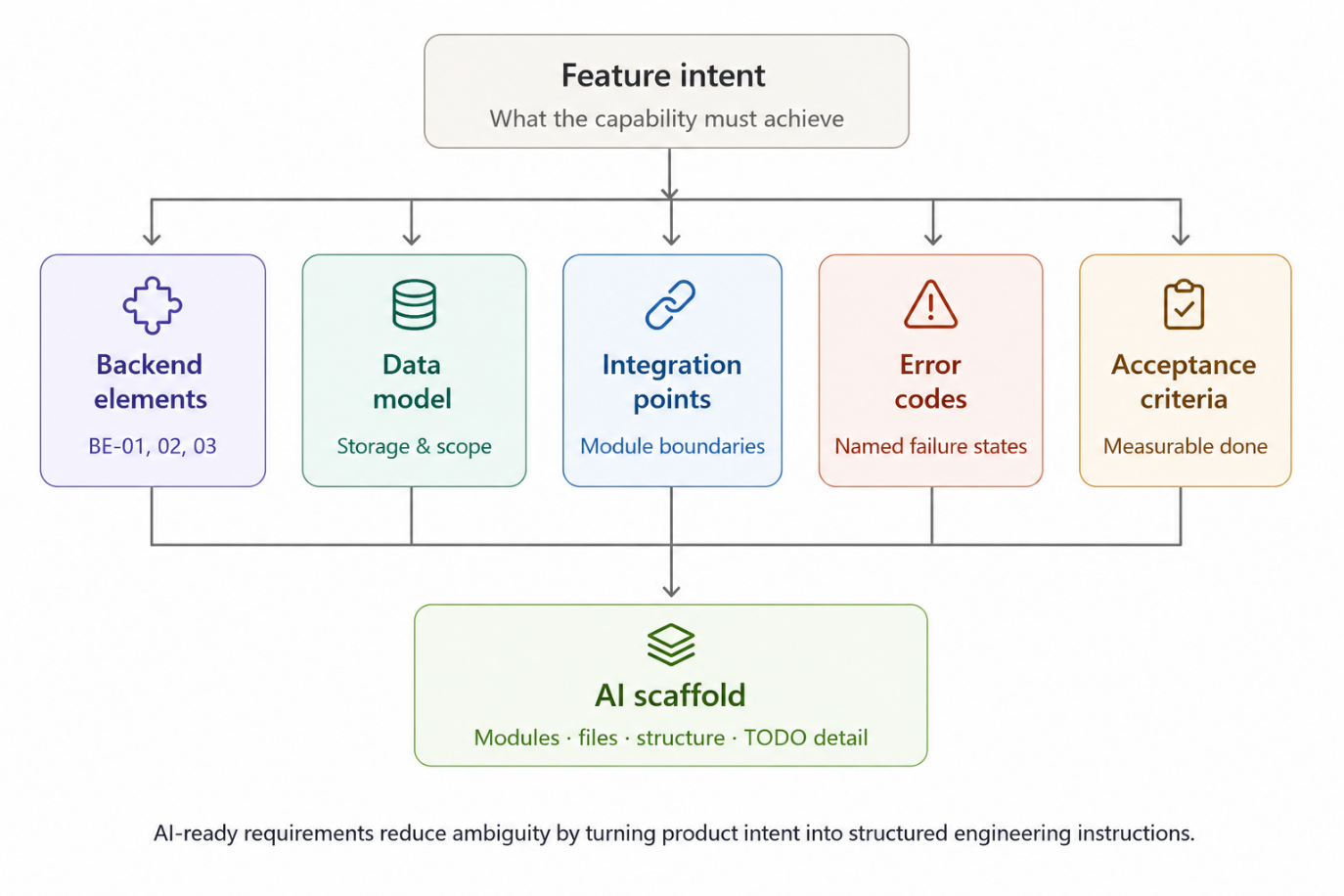
It defines how the system should behave, where data should live, how edge cases should be handled, which modules are involved, what errors should return, and how success should be measured.
During the ICE requirement process, the format evolved into a practical structure: feature intent, backend elements, data model, integrations, error handling, and acceptance criteria.
The Backend Element, or BE, structure became especially important. Each requirement was broken into buildable backend elements such as BE-01, BE-02, and BE-03. This helped separate responsibilities, assign work more clearly, and support parallel implementation without forcing every developer to understand the entire feature at once.
Requirement Element | Why It Matters |
Feature Intent | Defines what the capability is meant to achieve |
Backend Elements | Breaks the feature into buildable implementation units |
Data Model | Specifies storage, relationships, and tenant-level behavior |
Integration Points | Defines how the feature connects with adjacent modules |
Error Handling | Names expected failure scenarios and responses |
Acceptance Criteria | Defines the measurable standard for completion |
This changed the requirement from a product description into an engineering contract.
AI-Ready Requirement Structure
What Makes a Requirement AI-Ready?
Across the ICE requirement process, the strongest outputs came from requirements with five characteristics.
AI-Ready Requirement Discipline | What It Means |
Data Model Clarity | Defines where data is stored, how it is scoped, what fields matter, and what must be protected |
Named Error Conditions | Specifies failure scenarios, expected responses, and error behavior |
Module Boundary Definition | Clarifies whether a capability belongs in execution, validation, analytics, settings, tenant management, or another platform layer |
Operational Rules | Defines timing, cache behavior, validation gates, retries, sync intervals, and performance expectations |
Measurable Acceptance Criteria | States what must be true for the feature to be considered complete |
This distinction matters because AI does not reliably infer enterprise context unless that context is written into the requirement.
The better the requirement, the better the scaffold.
What This Solves for Enterprise Teams
For QA and engineering leaders, AI-ready requirements create value beyond faster code generation.
Value Area | What It Means |
Less Ambiguity | Teams clarify behavior, boundaries, and dependencies before development starts |
Better Handoffs | Product, QA, and engineering teams work from the same structured input |
Cleaner Architecture | Requirements define where responsibility belongs before scaffolding begins |
Lower Rework | Clear acceptance criteria reduce assumptions and implementation gaps |
More Reliable AI Output | AI-generated scaffolds reflect precise instructions instead of vague intent |
The biggest benefit is not simply speed.
It is consistency.
When requirements are structured clearly, teams can move faster without losing architectural control. Developers spend less time interpreting intent and more time implementing well-defined responsibilities.
Conclusion: AI-Ready Engineering Starts Before Code
AI is changing how software gets built.
But the real differentiator will not be who can generate code fastest. It will be who can define the right requirements, boundaries, and operating rules before generation begins.
The ICE requirement process showed that precise functional requirements can help AI convert engineering thinking into usable scaffolds and implementation paths. But the thinking still has to come first.
That is the larger lesson for enterprise teams: AI does not replace architecture, requirements, or engineering judgment. It amplifies them when they are clear.
This article continues Changepond’s Intelligent QA Operations series, moving from modular architecture to the requirement discipline needed for AI-assisted development.
In the next article, we look at how complex QA workflows can be structured into clean validation pipelines — and what that reveals about turning enterprise testing logic into executable architecture.
For more information, email us at info@changepond.com or visit www.changepond.com.
See How AI-Ready Requirements Improve Engineering Output →
Frequently Asked Questions
An AI-ready functional requirement defines intent, data behavior, module boundaries, integrations, error conditions, and measurable acceptance criteria. It gives AI-assisted development tools enough structure to generate more reliable scaffolds.
AI-assisted development depends heavily on the clarity of the input. Vague requirements can produce vague scaffolds, while precise requirements create cleaner structure and better handoffs.
It should include feature intent, backend elements, data model rules, integration points, error handling, timing expectations, and acceptance criteria. These details reduce ambiguity before development begins.
They reduce rework, improve collaboration between product, QA, and engineering teams, and make AI-assisted scaffolding more reliable. They also help teams maintain architectural control while moving faster.