
AI Guardrails In QA: How Enterprises Scale AI Testing Without Risk

AI is changing software testing faster than most QA teams expected.
Test cases can be generated in minutes. Regression can be optimized dynamically. Defect analysis becomes faster. Automation scripts evolve with changing interfaces.
That sounds like progress.
But here is the less discussed reality:
AI Can Also Make Weak QA Practices Scale Faster.
Poor test design becomes automated. Weak validation spreads across pipelines. Sensitive data moves through systems with less visibility. Teams gain speed — but sometimes lose control.
This is why the biggest challenge in AI-led Quality Engineering is no longer experimentation.
It is governance.
The real shift is not from manual testing to AI testing. It is from ungoverned experimentation to trusted, enterprise-scale Quality Engineering.
What Are AI Guardrails In QA?
AI guardrails in QA are governance controls that ensure AI-generated tests, scripts, recommendations, and quality signals remain secure, validated, compliant, and human-reviewed.
For QA leaders, guardrails answer practical questions:
- Can AI-generated outputs be trusted?
- Is sensitive test data protected?
- Are generated scripts validated before use?
- Can teams explain AI-driven recommendations?
- Where should human review remain mandatory?
Guardrails are not restrictions. They are what make enterprise adoption possible.
Why Enterprises Need AI Governance In Testing
Many organizations begin AI adoption with experimentation.
Teams generate test cases through prompts, accelerate automation, summarize defects, and improve regression planning. The early productivity gains are real.
But scale introduces new problems.
What happens when AI-generated scripts miss business-critical edge cases? What if production-like data is unintentionally exposed? What if regression recommendations quietly exclude high-risk scenarios?
This is where many AI initiatives stall.
Not because AI fails.
Because governance does.
According to the World Quality Report 2025, enterprise adoption of GenAI in Quality Engineering continues to grow, but privacy, governance, and operational readiness remain major barriers to scaling.
The lesson is clear:
AI in QA does not fail because of capability. It fails because of weak operational discipline.
The AI QA Guardrails Model
Security Governance
↓
Data Governance & Privacy
↓
Model & Code Integrity
↓
Human Oversight & Monitoring
The Four Guardrails That Make AI In QA Enterprise-Ready
| Guardrail Layer | What Can Go Wrong Without It |
| Security Governance | AI tools may access prompts, repositories, pipelines, or internal context without clear controls |
| Data Governance and Privacy | Sensitive test data may move through AI workflows without masking, lineage, or approval |
| Model And Code Integrity | AI-generated scripts may scale weak assertions, fragile logic, or incomplete coverage |
| Human Oversight and Monitoring | Teams may trust AI recommendations without understanding what was excluded or why |
1. Security Governance
AI systems used in QA should operate within enterprise security boundaries.
A QA team may use an LLM to generate test cases from requirements or user stories. That can accelerate testing. But risks emerge when governance is unclear.
What if internal architecture details are exposed through prompts? What if generated scripts enter pipelines without validation? What happens when AI tools access repositories, CI/CD systems, or production-like environments without clear permissions?
These are the conditions that make LLM-specific risks more serious in QA environments. OWASP’s LLM Top 10 identifies risks such as prompt injection, insecure outputs, and training data poisoning. In testing workflows, those risks can affect test design, automation quality, pipeline behavior, and release confidence.
Security governance should define:
- Which models are approved
- What systems they can access
- What data can be shared
- How outputs are reviewed before use
AI should operate as governed infrastructure not as an unmanaged shortcut.

2. Data Governance and Privacy
Testing often depends on sensitive business data.
That makes data governance one of the most important guardrails in AI-led QA.
The risk is simple:
AI can make weak data practices scale faster.
A testing team may use production-like datasets to improve accuracy. That improves realism but increases exposure if masking, anonymization, or access controls are missing.
Customer records, transaction histories, employee data, or regulated information can unintentionally move through AI workflows.
This is often where enterprise adoption slows. Testing teams see productivity gains, but security and compliance teams hesitate because the data model is unclear.
Enterprises need controls around:
- Data masking and anonymization
- Role-based access
- Secure test data lineage
- Controlled use of production-like datasets
The question is not only whether AI can generate better tests. It is whether it can do so without introducing new enterprise risk.
3. Model And Code Integrity
One of the biggest misconceptions in AI-led QA is that generated outputs are automatically correct.
They are not.
A test script may look well written while still containing weak assertions, missing edge cases, duplicate logic, or poor maintainability.
This becomes dangerous at scale. A weak script enters the automation suite. The suite grows. Months later, maintenance effort rises because fragile logic quietly spread into production.
The same applies to AI-driven regression intelligence. If teams cannot explain why tests were included or excluded, AI may reduce coverage in pursuit of speed.
Generated outputs should be treated with the same rigor as production code.
That means:
- Script validation
- Dependency scanning
- Review of automation logic
- Traceability between requirements and outputs
AI accelerates engineering. But engineering discipline still matters.

4. Human Oversight and Monitoring
AI does not remove accountability. It changes where accountability must sit.
Traditional QA depends on human checkpoints: test reviews, defect triage, and release approvals.
AI-led QA introduces new questions.
Who validates generated outputs? Who reviews recommendations? Who monitors drift? Who decides when human judgment overrides AI?
Imagine an AI engine classifies a release as low risk because major tests passed. But what if critical business workflows were excluded? What if recommendation logic cannot be explained?
That is where human oversight matters.
Enterprise teams need validation checkpoints, audit trails, continuous monitoring, review standards, and governance ownership.
Human oversight ensures AI remains a co-engineer not an unchecked decision-maker.
What We See Across Enterprise QA Programs
At Changepond, one of the most common reasons AI-led QA pilots stall is not model quality. It is governance clarity.
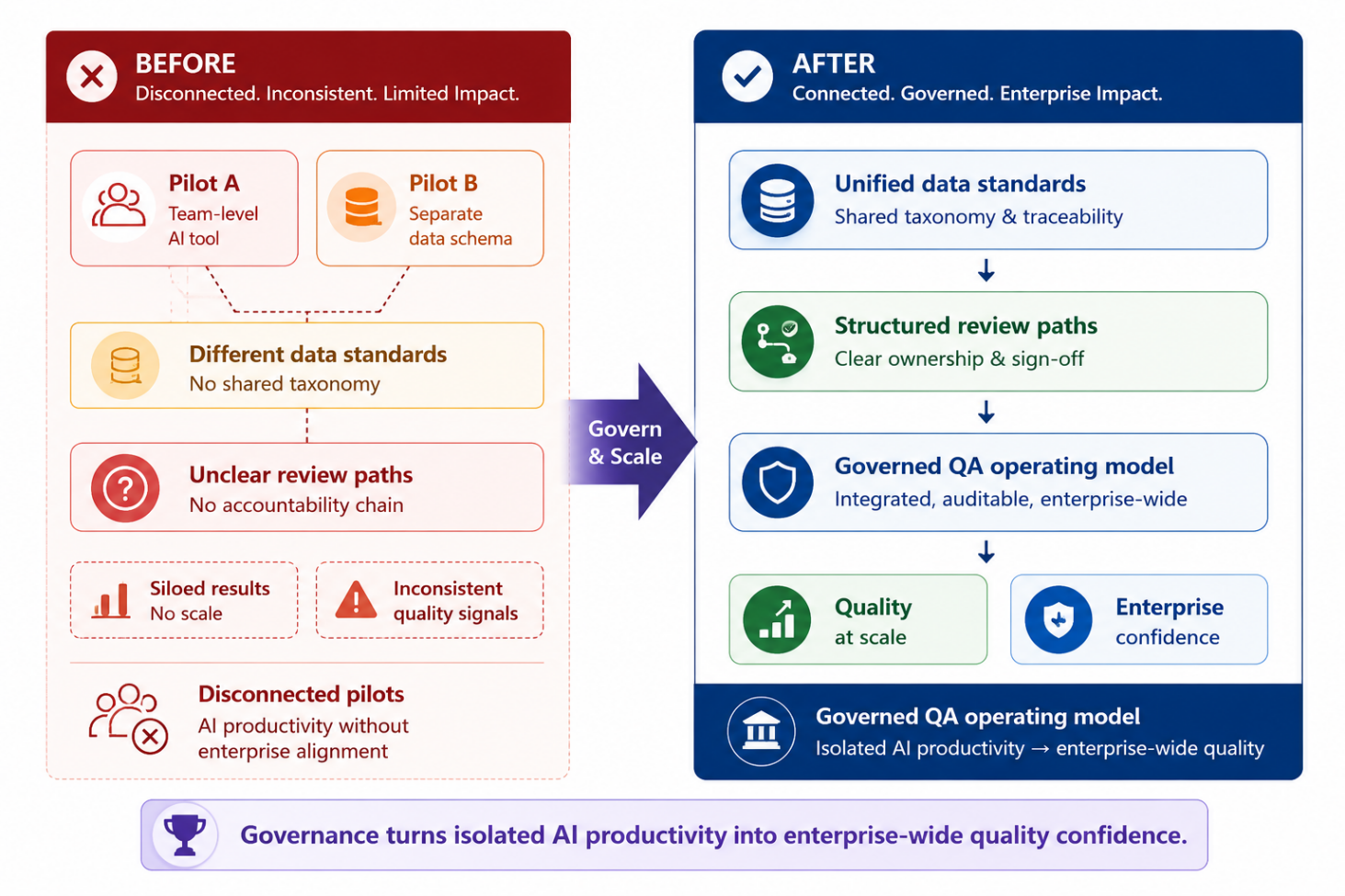
A typical pattern looks like this: one team proves that AI can generate test cases faster. Another team experiments with script creation. A third uses AI to summarize defects or prioritize regression. Each pilot shows promise, but each uses different data, review standards, tools, and approval paths.
The result is not scale.
It is scattered acceleration.
The strongest enterprise programs treat governance as an accelerator — not bureaucracy.
Because trust scales adoption.
From Scattered AI Pilots to Governed QA Scale
Conclusion: Governance Is What Makes AI In QA Scalable
AI can accelerate testing.
But governance determines whether it scales responsibly.
The organizations creating long-term value from AI in QA are not necessarily the ones moving fastest. They are the ones building the right controls around speed.
That means trusted outputs, protected data, and visible accountability.
The future of Quality Engineering will be intelligent.
But it will also be governed.
See Where AI Can Safely Improve Your QA Lifecycle
Frequently Asked Questions
AI guardrails in QA are governance controls that keep AI-generated tests, scripts, recommendations, and quality signals secure, validated, compliant, and human-reviewed.
Enterprises need AI governance to reduce risks around weak test coverage, sensitive data exposure, unreliable automation, and unvalidated outputs.
No. Strong guardrails improve trust and consistency, helping enterprises move from AI experimentation to production use.
AI in QA becomes enterprise-ready when it includes governance, explainability, secure data practices, monitoring, validation, and clear ownership.