
The Architecture Behind Intelligent QA Operations

60 Requirements.Became 18 Modules. One Big Shift in Enterprise QA Thinking.
In the first article of this series, we explored why fragmented validation has become one of the biggest operational bottlenecks in enterprise QA.
The issue is no longer whether enterprises have enough testing tools. Most already do. The real challenge is how those tools, workflows, reports, validation layers, and release signals operate together across the software delivery lifecycle.
This article moves from the problem to the architecture.
If QA orchestration is the missing layer, what should the platform behind it look like?
That question shaped the architecture behind ICE – Changepond’s internal approach to intelligent QA operations. Before the platform became code, it was mapped through functional requirements, engineering boundaries, validation disciplines, intelligence layers, and enterprise infrastructure needs.
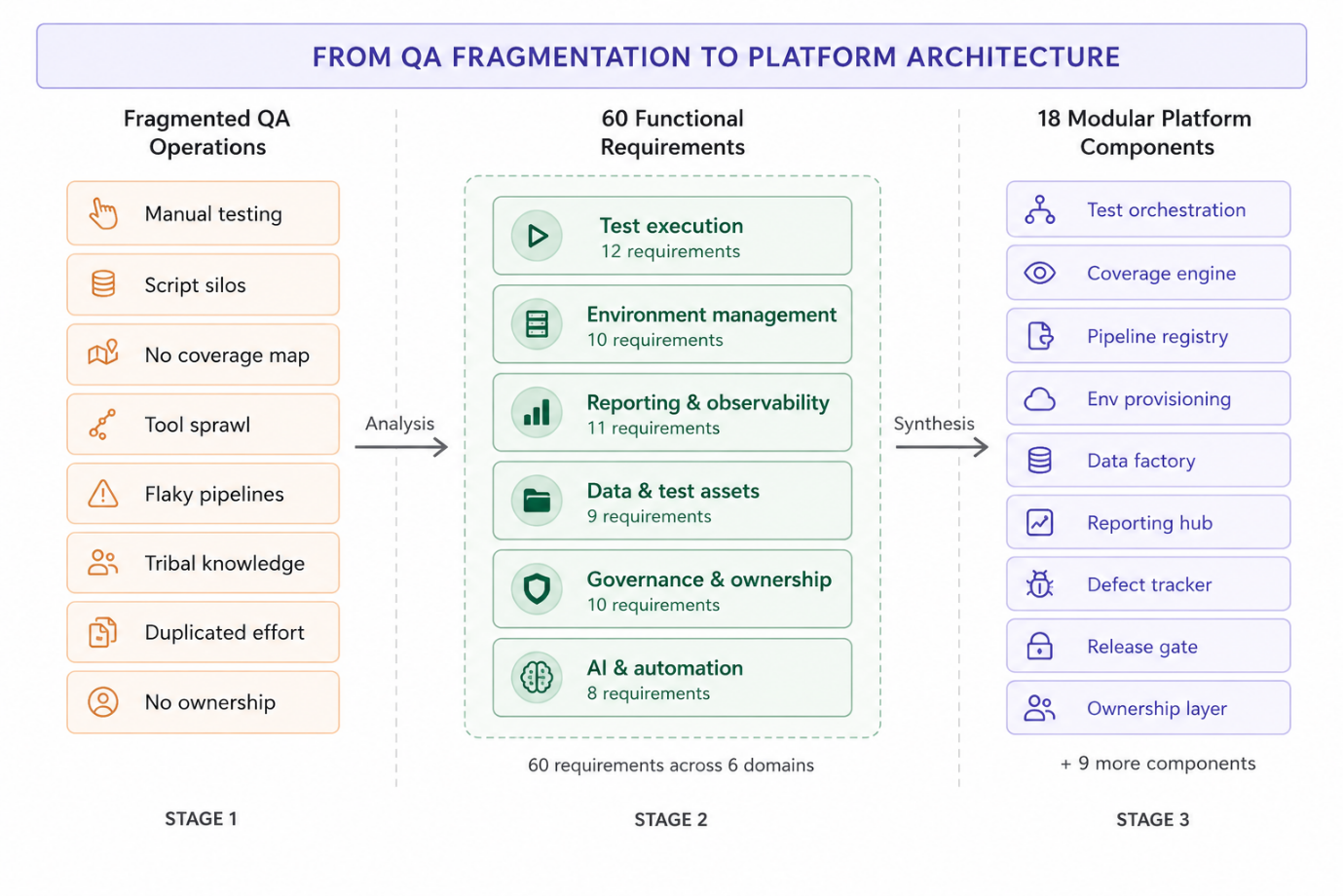
The result was a modular architecture: 60 functional requirements organized into 18 Maven modules.
This was not just a technical structuring exercise. It was a way to turn a fragmented QA problem into a buildable platform architecture.
Why Architecture Matters In Enterprise QA
Enterprise QA fragmentation cannot be solved by simply adding another testing tool. That only adds one more layer to an already complex environment.
Modern QA platforms need to solve a deeper architecture problem: how to bring validation capabilities, intelligence workflows, integrations, configuration layers, reporting systems, and enterprise controls into one coherent operating model.
That was the challenge behind ICE,the way QA is structured and executed within Changepond.
The platform needed to support multiple validation capabilities, including functional testing, accessibility validation, security analysis, API testing, network monitoring, performance validation, visual assurance, and cross-browser compatibility. But supporting many capabilities is not enough. Each needs a clear boundary, a defined responsibility, and a way to operate inside a unified platform without creating dependency chaos.
This is where architecture becomes more than a technical decision. It becomes the operating model.
The Principle That Shaped The Platform
The most important architecture decision was simple:
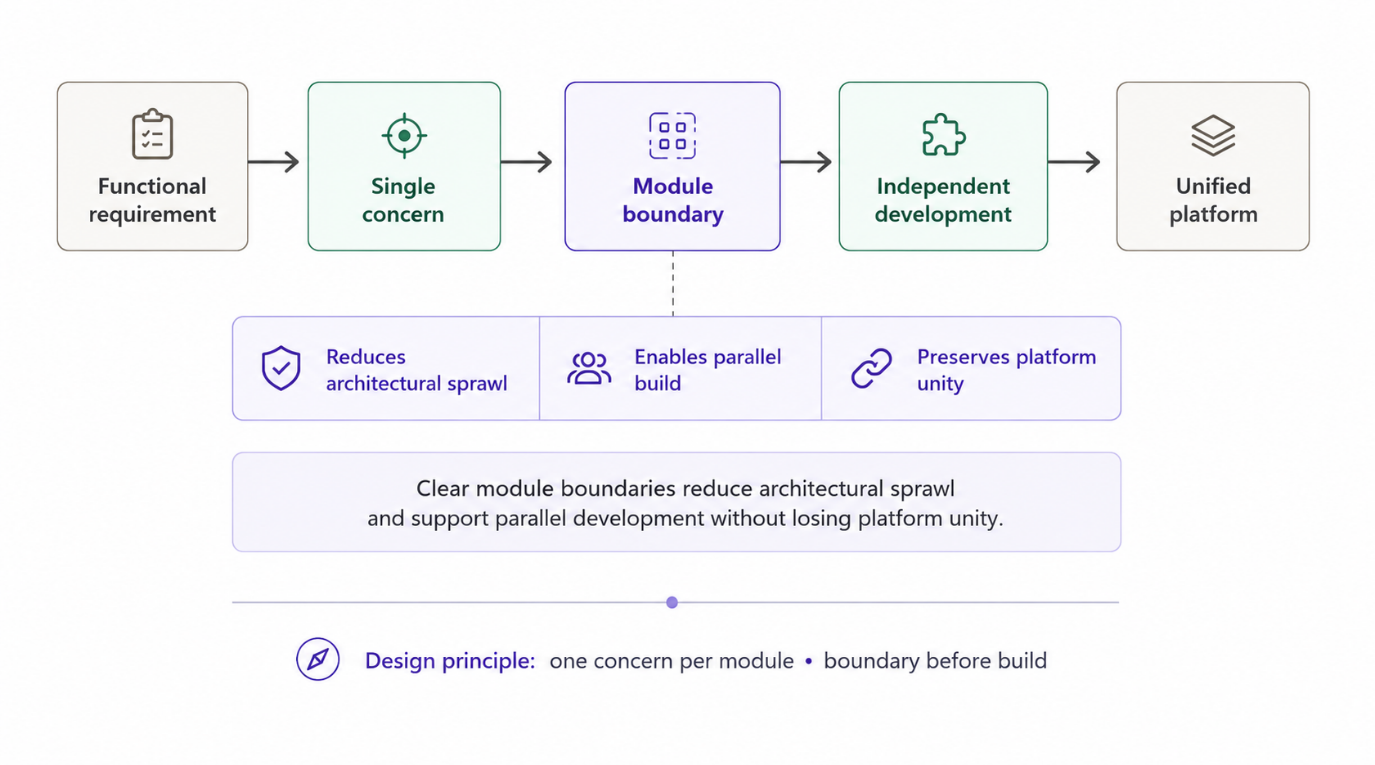
One module. One concern. One clear responsibility.
ICE was structured as a Maven multi-module project – not as one large monolith, and not as a complex microservices architecture with unnecessary deployment overhead. It was designed as a unified platform with modular internal boundaries.
Each module has a defined purpose. Each can be developed, tested, and extended independently. Each contributes to the larger platform without taking ownership of responsibilities that belong elsewhere.
That matters because enterprise QA platforms can easily collapse under their own ambition. A single “testing module” can start owning execution, analytics, reporting, API validation, accessibility, configuration, and governance. Over time, blurred boundaries make the platform harder to maintain and scale.
ICE avoids this by making responsibility visible in the architecture itself.
Industry Signal: AI In QA Needs Architecture to Scale
“According to the World Quality Report 2025 by OpenText, Capgemini, and Sogeti, nearly 90% of organizations are actively pursuing generative AI in quality engineering, but only 15% have achieved enterprise-scale deployment.” Source: Capgemini
That gap reinforces a critical point: AI in QA does not scale through isolated experiments. It needs the right architecture, governance, and operating model behind it.
How 60 Requirements Became 18 Modules
The 60 functional requirements were not distributed evenly across modules. That was intentional.
Some modules own one major capability. Others own multiple related requirements. The architecture follows responsibility, not arithmetic.
| Architecture Layer | Modules | Purpose |
| Validation Capability Modules | Accessibility, Security, API Testing, Network | Own specialized validation capabilities with distinct execution logic, scoring, reporting, and integration needs |
| Core Pipeline Modules | Upload, LLM, Test Case, Journey, Git, Execution | Manage how artifacts enter, move through, and execute inside the platform |
| Intelligence Modules | LLM Extensions, Agent, Validation | Support AI-assisted workflows, autonomous execution, validation gates, and quality intelligence |
| Platform Infrastructure Modules | Analytics, Settings, Tenant, Core JAR, SDK | Provide reporting, configuration, tenant controls, shared utilities, governance, performance-related engines, and external integration capabilities |
This structure gives the platform both breadth and control.
ICE can support multiple QA capabilities without forcing every capability into one overloaded architecture layer.
What This Architecture Solves For QA Teams
In current projects, this architecture supports use cases such as test execution, coverage mapping, pipeline monitoring, data and test asset management, governance ownership, AI-assisted validation, reporting, defect tracking, and release gates.
For enterprise QA leaders, modular architecture is not just an engineering detail. It solves practical delivery problems.
When responsibilities are unclear, every change becomes risky. Teams need more coordination. Developers need more context. Dependencies multiply. Delivery slows down.
When responsibilities are clear, teams can work in parallel without stepping on each other.
Each module can carry its own entities, repositories, services, controllers, migrations, and test stubs. Developers can focus on a specific responsibility without needing to understand the entire platform before contributing.
For enterprise teams, this creates four practical advantages:
Value Area | What It Means |
Faster Parallel Development | Teams can work across modules without waiting for every platform decision to be centralized |
Lower Maintenance Complexity | Changes are easier to isolate when each module owns a defined responsibility |
Better AI Readiness | LLM infrastructure, AI-assisted workflows, validation gates, and execution flows can be governed separately |
Stronger Enterprise Governance | Tenant controls, settings, audit trails, analytics, security foundations, and integrations have a defined place |
Clear module boundaries reduce dependency burden. They make the platform easier to build, govern, and extend.
Conclusion: Architecture Is the Operating Model
Enterprise QA is entering a phase where platform architecture matters as much as testing capability.
The goal is not just to organize code. It is to create a structure that can support modular ownership, parallel development, AI-assisted workflows, enterprise governance, and connected quality operations at scale.
The 60 functional requirements defined what the platform needed to do. The 18 modules defined how the platform could actually be built.
This article continues Changepond’s Intelligent QA Operations series, moving from the orchestration crisis to the architecture decisions behind a unified QA platform.
In the next article, we look at how functional requirements need to be written when AI becomes part of the development process. The focus shifts from platform architecture to requirement quality — and why clear, structured requirements now directly shape architecture, scaffolding, and engineering output.
For more information, email us at info@changepond.com or visit www.changepond.com
CTA See How Modular QA Architecture Supports Intelligent Orchestration. →
Frequently Asked Questions
What is modular QA architecture?
Modular QA architecture separates testing, execution, intelligence, analytics, and infrastructure responsibilities into clearly defined modules. This reduces dependency complexity and supports scalable platform development.
Why were 60 functional requirements organized into 18 modules?
They were organized into 18 modules to create clear ownership boundaries across validation capabilities, pipeline workflows, AI-assisted features, and enterprise infrastructure capabilities.
How does modular architecture reduce QA fragmentation?
It gives each capability a defined responsibility inside a unified platform model, allowing testing, execution, analytics, governance, and intelligence workflows to operate through a connected architecture.
How does AI fit into modular QA architecture?
AI-assisted capabilities are organized through defined intelligence modules and LLM integration layers, allowing test generation, natural language import, exploratory discovery, validation checks, and agent workflows to operate as governed platform capabilities.