
The AI Testing Maturity Curve For Enterprise QA

The AI Testing Maturity Curve: From Experiment To Enterprise Capability
AI adoption in Quality Engineering is not a switch. It is a progression.
Many enterprise QA teams begin with AI-generated test cases, scripts, and defect summaries. But meaningful business value comes when AI moves beyond isolated pilots and becomes part of how testing is planned, executed, governed, and measured.
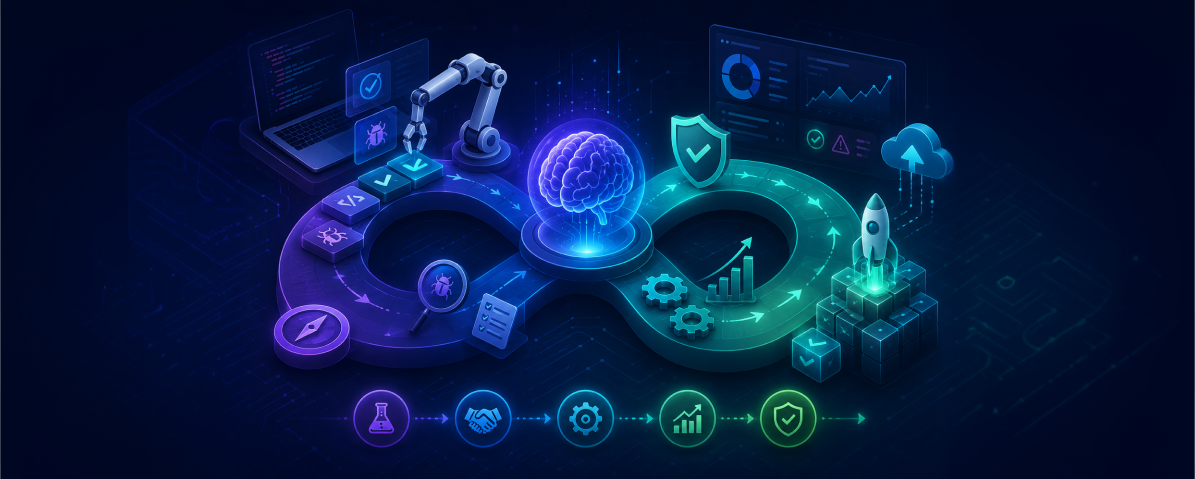
At Changepond, we see enterprise QA maturity evolving across four stages.
Stage 1: Experimentation
Teams begin by testing AI in small areas of the QA lifecycle.
- This usually includes:
- AI-generated test cases
- Script creation support
- Prompt engineering
- Output validation
- Early productivity gains
At this stage, AI helps teams explore possibilities. Human review remains high, and outputs often require validation before they can be trusted in production workflows.
Stage 2: Adoption
AI becomes more valuable when it understands business and testing context.
Historical defects, regression assets, business workflows, and domain knowledge improve the quality of AI-generated outputs. QA teams begin using AI not only to create test assets but also to strengthen coverage, identify testing gaps, and reduce repetitive effort.
AI shifts from experimentation to a practical QA assistant.
Stage 3: Scaling
Greater value emerges when AI becomes part of enterprise delivery.
At this stage, AI-led testing integrates with CI/CD pipelines, regression planning, defect prediction, and release readiness checks. Continuous testing becomes more aligned with continuous delivery.
Quality signals begin influencing engineering decisions.
Instead of only asking, “Did the tests pass?”, teams begin asking, “What is the risk of releasing now?”
Stage 4: Maturity
At the maturity stage, AI becomes governed Quality Engineering infrastructure.
Reusable frameworks, testing standards, audit trails, predictive analytics, and risk-based insights help QA leaders move from reactive testing to proactive quality management.
This is where enterprise QA becomes more than test execution. It becomes a strategic capability that improves release confidence, customer experience, and operational resilience.
But maturity also introduces a new responsibility: governance.
Why Governance Matters In AI-Led QA
AI can accelerate testing. But without governance, it can also create inconsistent scripts, weak coverage, duplicated effort, and unreliable outputs.
Enterprise QA teams need clear controls around:
- Test data usage
- AI-generated script validation
- Coverage traceability
- Security and compliance
- Human review checkpoints
- Reusable automation standards
AI-led QA succeeds when speed is balanced with trust, consistency, and operational discipline.
Tools And Frameworks Powering AI-Led QA
AI-led Quality Engineering is only as strong as the ecosystem it integrates with.
At Changepond, we operationalize AI across scalable testing environments using:
- Selenium
- Playwright
- Tricentis Tosca
- Robot Framework
- Python-based automation frameworks
- Functional, regression, API, and visual testing workflows
- CI/CD-integrated testing pipelines
These tools are not used in isolation. They are strengthened with AI to reduce manual effort, improve resilience, accelerate execution, and support more informed release decisions.
The Enterprise Shift: From Automation To AI-Led Quality Engineering
Most organizations do not stall because AI testing does not work. They stall because AI testing is not connected to real QA workflows, delivery pipelines, and governance models.
At Changepond, we help enterprises move from fragmented automation to AI-led Quality Engineering by combining testing expertise, automation frameworks, AI accelerators, and delivery discipline.
The outcome is not just faster testing. It is better coverage, stronger release confidence, and a QA function designed to support enterprise delivery at scale.