
How AI Transformed Our Testing Function into a Mature Model

From Experiment to Expert: How AI Transformed Our Testing Function into a Mature Model
Everyone is talking about AI in Software Testing, but few talk about the journey to get there. It doesn’t happen overnight. You don’t simply “turn on” AI and watch your bugs disappear.
Over the past year, our team has moved from tentative experiments to a fully mature, AI-integrated Quality Assurance model. It was a journey of learning, refining, and scaling.
Here is the inside story of how we evolved our testing function through four distinct stages of AI maturity and what that looks like in practice.
1.The Initial Stage: The “Messy” Experiment
“Curiosity mixed with skepticism.”
At the very beginning, we treated AI like a new toy. We didn’t have a roadmap; we just wanted to see what it could do. The team experimented with using GenAI to write simple test cases and generate basic scripts.
The Reality Check:
It wasn’t magic. We quickly realized there was a steep learning curve. We had to understand how Large Language Models (LLMs) interpreted our requirements. We spent days refining prompts only to get inconsistent results.
The Win: Even though the output required heavy editing, we saw the potential. We realized that AI could handle the “blank page problem,” speeding up the initial draft of test design significantly.
2.The Adoption Stage: Context is King
“ Building trust and finding focus.”
As we gained familiarity, we realized that AI is only as good as the data you feed it. We moved from generic prompts to context-aware training. We began feeding the AI our specific domain context—our detailed user stories, our acceptance criteria, and even our past defect history.
The Turning Point:
The accuracy skyrocketed. Because the AI understood our business logic, the test scripts became reusable rather than throwaway code.
The Win: Manual correction time dropped drastically. This was the stage where the team stopped rolling their eyes at AI and started trusting it as a genuine productivity partner.
3.The Scaling Stage: Integration & Shift-Left
“Automation and velocity.”
Once we trusted the tools, we had to operationalize them. We took the learnings from our isolated experiments and embedded them into our actual CI/CD pipelines. This wasn’t just about writing tests anymore; it was about Continuous Test Generation.
The Strategy:
We focused on “Shift-Left” testing using AI to analyze code and generate tests before the code even hit the QA environment.
The Win: We learned the delicate balance of “Human + AI.” We established a workflow where AI handles the volume and repetition, while human testers focus on validation and complex edge cases. We ensured speed without sacrificing quality control.
4.The Maturity Stage: Proactive Quality Assurance
“ AI is the new standard.”
Today, AI isn’t an “add-on” or an “experiment.” It is the standard operating procedure for our test design and automation. We have established best practices, reusable prompt libraries, and strict governance models.
The Evolution:
We have evolved from Reactive (finding bugs after they happen) to Predictive (using AI to predict where bugs will happen).
The Win: We aren’t just finding defects faster; we are preventing them. Our QA model is now a strategic asset that drives business velocity.
The Big Picture: AI in the Software Testing Life Cycle (STLC)
So, where does AI fit into the daily workflow now that we are mature? We have mapped AI capabilities across the entire STLC
1.Requirement Analysis
Instead of manually reading 50-page requirement docs, AI scans them to identify ambiguities, contradictions, and missing logic before a single line of code is written.
2.Test Planning
AI analyzes historical data to estimate testing efforts and predict high-risk areas, allowing us to allocate resources where they are needed most.
3.Test Design & Generation
Generative AI automatically creates test cases, edge case scenarios, and maps them to the Requirement Traceability Matrix (RTM).
4.Test Execution
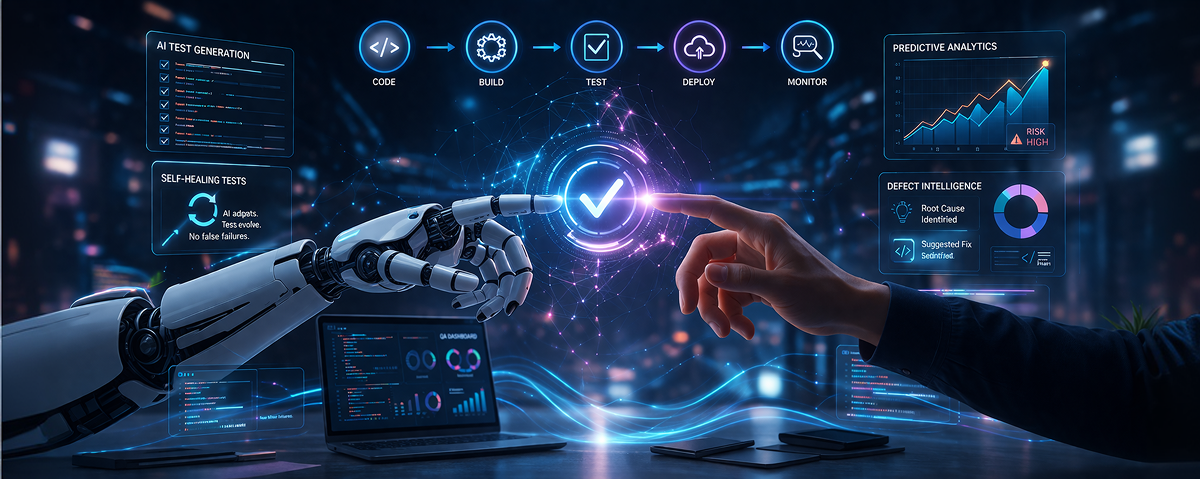
This is where Self-Healing Automation comes in. If a UI element changes (e.g., a button moves), the AI detects it and updates the test script in real-time, preventing false failures.
5.Defect Logging & Analysis
When a bug is found, AI auto-triages it. It predicts the root cause, suggests a fix to the developer, and categorizes the severity based on past data.
Conclusion
The transition to an AI-mature QA model isn’t about replacing testers it’s about elevating them. At ChangePond, this journey has been deliberate, disciplined, and deeply rooted in our commitment to delivering quality at speed.
By moving through four distinct stages from inconsistent experiments to predictive, proactive maturity we have built a testing function that doesn’t just keep pace with development; it leads it. AI is no longer a tool we evaluate. It is the standard we operate by.
For organizations wondering where to begin, the answer is simple: start with curiosity, invest in context, and scale with confidence. ChangePond’s experience proves that with the right approach, AI in QA becomes not just an operational upgrade but a true strategic advantage.
Where Does Your QA Stand on the AI Maturity Scale?